Marvel
Super Heroes
STORY:
The story behind Marvel Super Heroes is inspired by the famous comic saga
known as the Infinity
Gauntlet, published in 1991. The infinity gauntlet is wielded by Thanos
and allows him to use all the Infinity gems simultaneously.
|

|
|
Capcom killed it in 1995...
visual masterpiece!
|
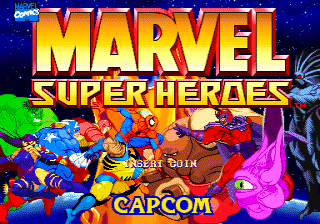
REVIEW: Back in December 1994... Capcom
wowed Marvel and Street Fighter fans alike with
X-Men:
Children of the Atom — making a huge statement with large, colorful character
sprites, ultra smooth animation, and fast-paced, exciting gameplay. To further prove what the amazing artists over at Capcom could do with the Marvel license, the team brought
together an even more iconic cast of Marvel characters in 1995's Marvel
Super Heroes, debuting legendary comic-book icons such as: Spider-Man, Iron Man, The Hulk,
and Captain America into the Capcom and fighting game universe. A few returning X-Men
from the previous title also take their rightful place on the roster.
|
|
|
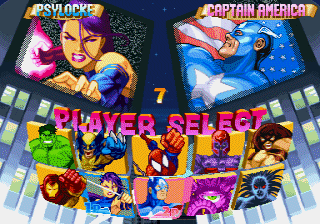
Marvel
Super Heroes (1995) character selection screen
|
In more ways than one, Capcom's second attempt at a Marvel-themed 2D fighter raised the
bar yet again in the arcade and console 2D fighting game climate of 1995-1997. Marvel Super Heroes really
was a breakthrough 2D fighting game in terms of visuals and gameplay, paving the way for
what would later become Capcom's Marvel Versus Series. Everything about
this game shines and begs you to play it. The combos and gem system are
excellent to be honest!
|
|
|
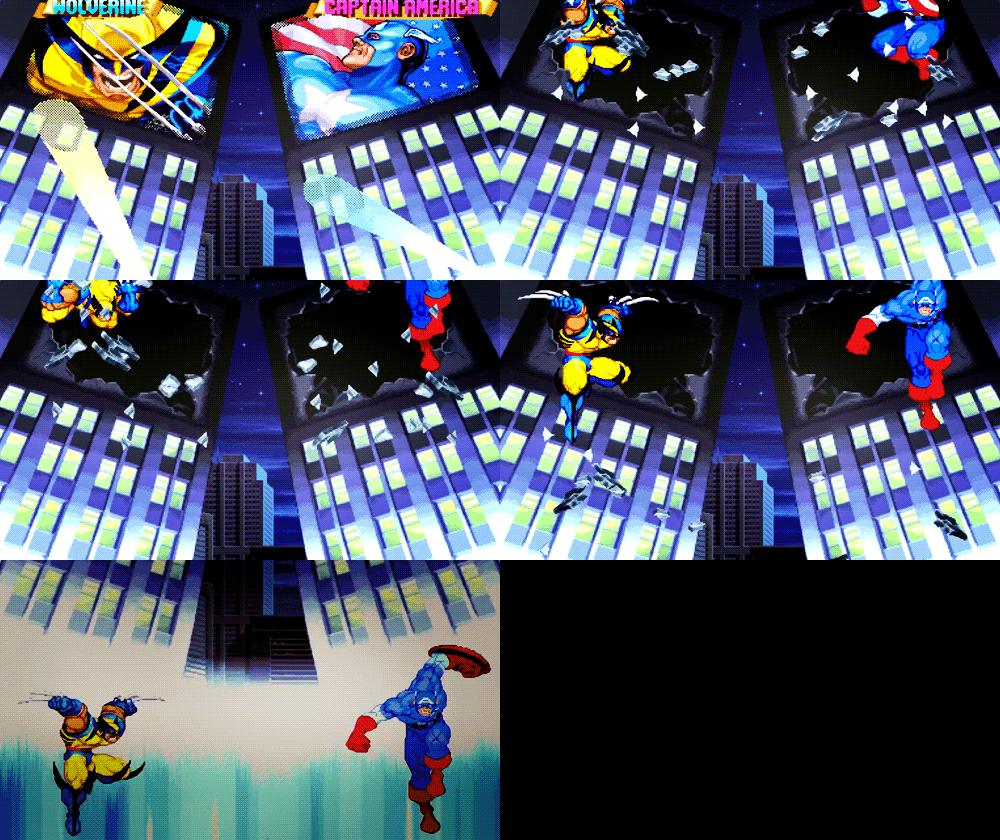
THIS
is how you do a versus screen.
|
Even from a casual 2D fighting game fan's perspective (or from
the perspective of a non video game player), Marvel Super Heroes is an
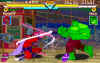
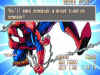
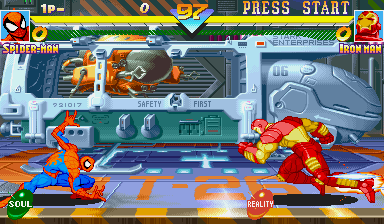
impressive visual feat. What comic book nerd wouldn't want to see The Hulk finally duke
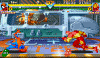
it out with Juggernaut, or watch a beautifully-animated dream match of Spider-Man
Vs. Captain
America? No doubt, Capcom's beautiful 2D sprite-work was very much ahead its time, and
actually still look
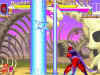
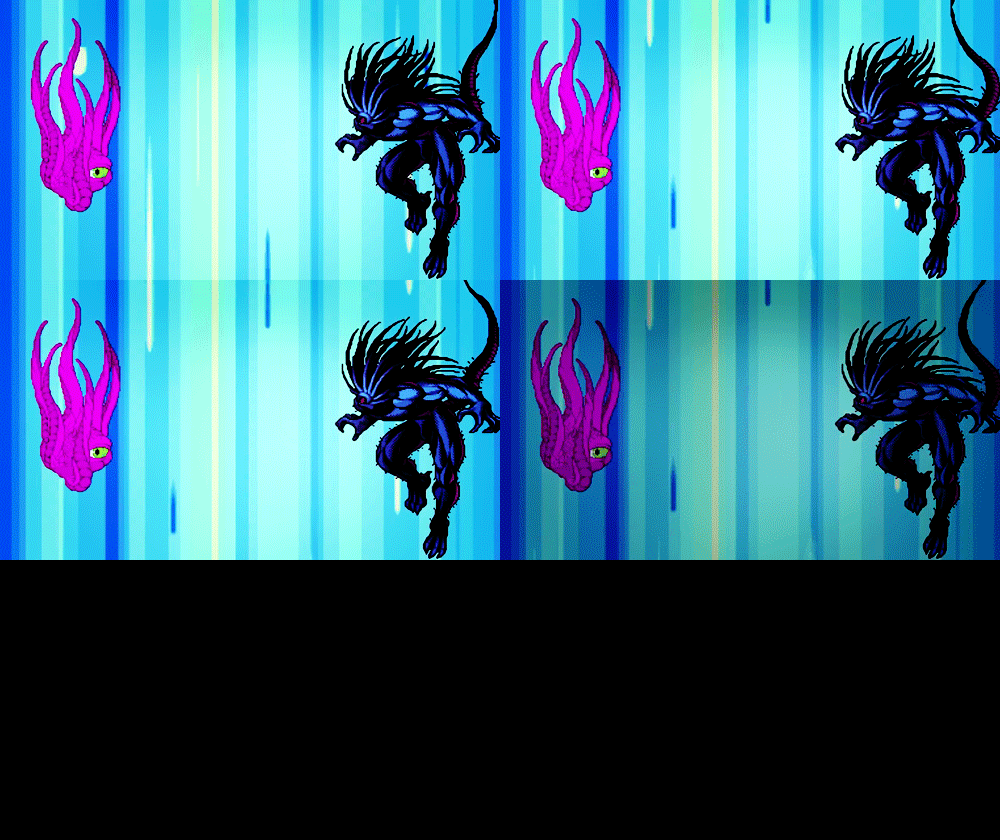
awesome to this day! Marvel Super Heroes presented some of the largest and beefiest 2D character sprites to date, and even the big guys like Hulk and Blackheart show off ultra-smooth animations
— something that not many 2D or 3D fighting games at the time could pull off quite so
convincingly.
|
|
|
Dream
match-ups made by Capcom... eat that SNK!
|
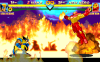
Not only does Marvel Super Heroes look
incredibly stylish and smooth... the gameplay was very innovative and
boundary-pushing for the time and most importantly, fun! The exciting and
visually stimulating Infinity Gem system offers a deeper level of gameplay than
most 2D fighters of the time period (we'll talk more about that later). Marvel Super Heroes also refined the air-combo system from X-Men: COTA,
making air-combos much more intuitive and fun to perform and master. While the combo system
is open-ended and fun for casual / advanced players, the system contains some ridiculous (and very cheap) infinite combos that expert players
can pull off with ease (and steal a round in literally seconds).  Infinite combos "break the game" competitively, but that doesn't mean
they're not fun to learn and pull off against the computer.
Infinite combos "break the game" competitively, but that doesn't mean
they're not fun to learn and pull off against the computer.
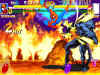
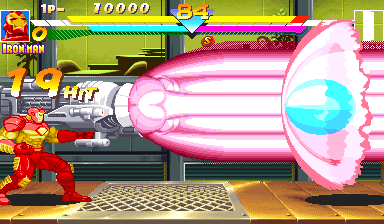
In addition to the crazy and highly entertaining combos, Marvel Super Heroes presented some of the flashiest special moves and most dramatic super moves to ever appear in a 2D fighting game to date. Hearing the Marvel
icons scream out their super moves as they perform them definitely enhanced the effect as well!  PROTON CANNON!!! ...GAMMA CRUSH!!! ...MAXIMUM SPIDER!!!
  (All of these are now legendary, timeless super moves than any fighting game player worth their salt knows and loves. Don't forget many of them originated in this game.) On the subject of voice acting, MSH could have gone in a very wrong direction with the wrong talent, but
needless to say, Capcom got the right people for the job... and every character sounds amazing.
(All of these are now legendary, timeless super moves than any fighting game player worth their salt knows and loves. Don't forget many of them originated in this game.) On the subject of voice acting, MSH could have gone in a very wrong direction with the wrong talent, but
needless to say, Capcom got the right people for the job... and every character sounds amazing.
|
|
|
"Proton
Cannon!" debuted in 1995.
|
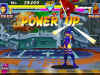
On top of the solid and fun gameplay engine, the ability to pick up
and use "Infinity Gems" to enhance your character's abilities
mid-fight is also an innovative and fun gameplay element. The types of Gems that players can use during gameplay include: Time
Gem (allowing faster movement speed), Space Gem (enabling super
armor), Soul Gem (life recovery), Power Gem (powered-up attacks), Reality Gem (additional attack effects), and the Mind
Gem (allows character to
recover 2 energy levels very quickly). Characters can pick up numerous Gems at
once, stacking them. However, if a character is hit by a powerful attack, they
will drop one of there Gems which could be picked up by the opponent.
Furthermore, certain Gems give specific characters unique enhancements (ex.
Reality Gem gives Blackheart temporarily invisibility)! Part of the fun is experimenting with what each character can do with each Gem. Brilliant!
As a fighting game... Marvel Super Heroes was a noticeable improvement over X-Men:
Children of the Atom, and even brought back some of the earlier cast (which
returning players certainly appreciated). Overall, Marvel Supers Heroes is a
fighting game anyone can pick up and play, but contains plenty of depth
for the hardcore players as well. In high level play, the-ultra cheap infinite combos
and tricks that players can use to dominate arguably "break" the game... but you can't really fault a 1995
fighting game for balance issues. (Plus, if you meet a fellow player who knows
some infinites, it's still a fun gameplay experience on its own). 
|
|
|
The
heroes look great... but the villains are on another level.
|
|
|

| Page Updated: |
July
2nd, 2024
|
| Developer(s): |
Capcom |
| Publisher(s): |
Capcom |
| Designer(s): |
Takeshi
Tezuka, Tetsuya Iijima, Atsushi Tomita, Kiyoshi
Nishikawa, Kei Hiratou, Satoru Kimura
|
| Artwork By: |
Akiman Character Art
Arthur Adams Poster / Promo Art
|
| Platform(s): |
Arcade, PlayStation, Sega Saturn, PSN, XBL
|
| Release Date(s): |
Oct. 24th, 1995
 Arcade Arcade
Nov. 1995  Arcade Arcade
Aug. 8th, 1997 Saturn
Sept. 25th,
1997
PS1
Sept. 29th, 1997 PS1 / Saturn
Sept. 25th, 2012 PSN - in MVC: Origins
Sept. 26th, 2012 XBLA - in MVC: Origins |
| Characters: |
Hulk,
Wolverine,
Spider-Man,
Magneto,
Juggernaut,
Iron Man,
Psylocke,
Captain
America, Shuma-Gorath, Blackheart,
Dr. Doom, Thanos,
Anita ( version) |
|
|
|
Featured Video:
|
|
|
| Related Games: |
X-Men:
Children of the Atom, X-Men Vs. Street Fighter, Marvel Super Heroes
Vs.
Street Fighter, Marvel Vs. Capcom, Marvel
Vs. Capcom: Origins, Marvel Vs. Capcom 2, Marvel
Vs. Capcom 3, Ultimate
Marvel Vs. Capcom 3, Marvel Vs. Capcom: Infinite,
Darkstalkers, Night
Warriors: Darkstalkers' Revenge, King of Fighters '95, Darkstalkers
2, Fatal Fury 3, Street
Fighter Alpha, Mortal Kombat 3,
Golden Axe: The Duel, Killer
Instinct 2, Galaxy Fight |
|

|
|
Gameplay
Engine
|
8.5 / 10
|
|
Story
/ Theme
|
9.5 / 10
|
|
Overall
Graphics
|
9.0 / 10
|
|
Animation
|
10 / 10
|
|
Music
/ Sound Effects
|
9.0 / 10
|
|
Innovation
|
9.5 / 10
|
|
Art Direction
|
10 / 10
|
|
Customization
|
6.5 / 10
|
|
Options / Extras
|
7.5 / 10
|
|
Intro / Presentation
|
9.5 / 10
|
|
Replayability / Fun
|
8.0 / 10
|
|
"Ouch" Factor
|
9.0 / 10
|
|
Characters
|
8.5 / 10
|
|
BOTTOM LINE
|
8.9
/
10
|
|
Review based on Arcade
version
|
|
| Final
Words: |
An artistic and visual triumph... 1995's Marvel Super Heroes was another big statement from Capcom, perhaps changing the face of fighting games forever.
Other 2D fighters from the era just couldn't compete with this game (and we all
know there were a lot of them.) Capcom proved they could do way more than just
offering great new Street Fighter and Darkstalkers
installments in the mid 90's. Marvel Super Heroes changed the game and
paved the way for the 2D greatest crossover games of all time!
No other 2D fighting games of the
era even came close to the animation quality, groundbreaking aesthetic, sound
design, or gameplay prowess of Marvel
Super Heroes. As a fighting game, it opened the door to faster gameplay,
crazier combos, and huger super moves.
Technically, Marvel Super Heroes is fun to learn... but on the flipside,
is actually a broken game. I call Marvel Super Heroes a visual
masterpiece, but any MSH player who knows an infinite combo or two would tell
you there are some crazy, laughable, but also annoying exploits and balance
issues with this game.
Fans of
X-Men: Children of the Atom also
might've felt shorted because many great characters from
the prequel were sadly missing in action.  (It seems like they could've just stuck them in this game.) Clearly, Capcom wanted to focus mainly on the "big names"
of Marvel this
time around. Even with the slightly smaller character roster, MSH felt more
comprehensive than Capcom's first Marvel fighting game, and was more fun to
play, in my book. Thanks to the solid
visuals and gameplay, Capcom had themselves yet another hit at the arcades and
on home
consoles.
(It seems like they could've just stuck them in this game.) Clearly, Capcom wanted to focus mainly on the "big names"
of Marvel this
time around. Even with the slightly smaller character roster, MSH felt more
comprehensive than Capcom's first Marvel fighting game, and was more fun to
play, in my book. Thanks to the solid
visuals and gameplay, Capcom had themselves yet another hit at the arcades and
on home
consoles.
While a head-turner at arcades and a solid console title, Capcom's Marvel
Super Heroes didn't have quite the competitive longevity of some other 90's
fighters as it
was quickly succeeded by 1996's groundbreaking X-Men
Vs. Street Fighter along with this game's successor, 1997's Marvel
Super Heroes Vs. Street Fighter. All great titles that continued to
change the face of 2D fighting games. (Damn, that sure was an awesome time to be
an arcade-goer.) *sigh* Moment of
nostalgia.... ^__^
Worth mentioning... the clever fighting styles Capcom created for Marvel's
iconic heroes and villains
remained unchanged when they reappeared in Capcom's various Versus Series
sequels (including MVC3 which was 17 years after this game!!!). There's a
reason for that, and its partly due to the brilliant animation we all
experienced in this special game.
Also, each character's fun and interesting moveset design and amazingly cool
combos made it intuitive for returning players! Also
worth noting, several of the incredibly catchy BGM theme songs that debuted in
this game carried over to
many of the sequels — getting cool remixed versions. But I digress. In
addition to being a well-put-together 2D fighting game, Marvel Super Heroes and
all the games that would follow it would continue to be the best kind of
fan service for Marvel and Capcom fans, alike! And it wasn't just the big names
and the popularity of Marvel's characters, it was Capcom's execution that made
this series outstanding.
~TFG Webmaster | @Fighters_Gen
|
|
|
|
|
|
|
|
|
|
|
|
|
 View more
products at
View more
products at